

Regd. No. 131741/071/072 WhatsApp No. +977 9841073239 himalayadarshantreks@gmail.com

"Experience Naturally Nepal With Us"
Per person - All price inclusive
1 ReviewTrek to Gokyo Lakes with Experts—Himalaya Darshan Treks, Your Local Guide to the Himalayas!
Nepal is a trekking paradise and offers a plethora of climbing routes that will leave you spellbound. One such trekking route is the Gokyo Lake Trek, which is part of the Everest region treks. The tour takes you through some of the most breathtaking scenery in the Himalayas, culminating in the stunning Gokyo Lake. The Gokyo Lake Trek is a must for those seeking an escape from city life.
The Gokyo Lake Trek is a moderate hike that requires a basic level of fitness. This trek will take you through steep climbs and downhills, but with the right preparation and training, anyone can complete it. The trip begins with a scenic flight to Lukla, followed by a hike through the Dudh Koshi River valley.
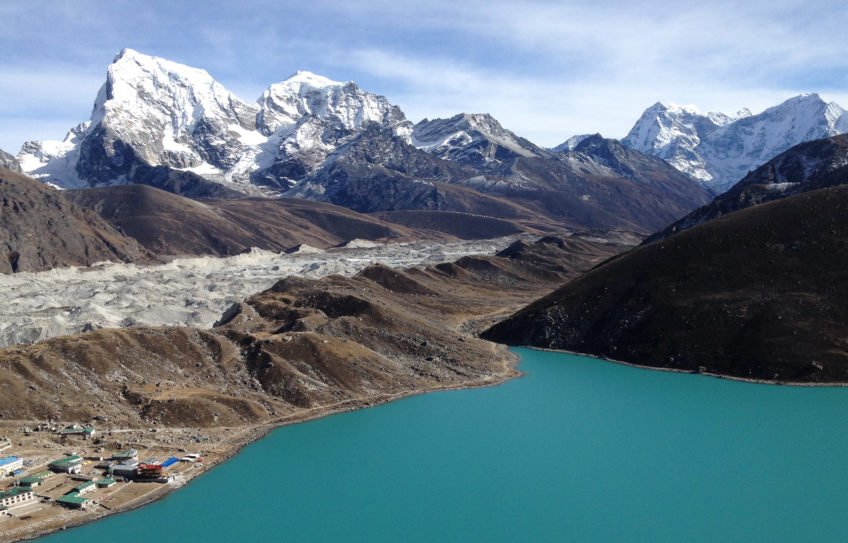
The route to Gokyo Lake takes you through beautiful pine forests, Sherpa villages, and suspension bridges. You’ll pass through Namche Bazaar, a gateway for Everest Region treks. A hike to Gokyo Ri offers a breathtaking view of Mt. Everest, Lhotse, Makalu, and Cho Oyu (more than 8000 meters). Likewise, also enjoy the outstanding view of Ngozumpa Glacier (the longest glacier in the Himalayas), the Deep Valley, and the surrounding views.
Breathtaking mountain views: The trek offers breathtaking panoramic views of some of the world’s tallest mountains, including Mount Everest (8,848 m), Lhotse (8,516 m), Cho Oyu (8,201 m), and Makalu (8,463 m). The view from Gokyo Ri, an observation point at 5,360 m above sea level, is particularly popular.
Lake Gokyo: The trek will take you to a series of fascinating lakes known as Gokyo Lakes. These blue lakes are located at high altitudes and are a sight to behold.
Sherpa Culture and Tradition: Along the walking route, you will have a chance to experience the unique Sherpa culture and its warm hospitality. Visit traditional Sherpa villages like Namche Bazaar and engage with the locals to understand how Buddhism influences their lifestyle, traditions, and customs.
Sagarmatha National Park: This trek is part of Sagarmatha National Park, a UNESCO World Heritage Site. The park is home to various flora and fauna, including rare species such as the snow leopard and the red panda. Walking through the park allows you to appreciate its natural beauty and conservation efforts.
Overcome difficulties: The trip includes passing difficult high-altitude passes, such as Chola Pass (5,420m) or Renjo La Pass (5,360 m), depending on the particular route chosen. These passes offer thrilling adventures and incredible views but require adequate climbing and acclimatization experience.
However, this trek does not lead directly to Everest Base Camp. It can be combined with a detour to this iconic destination. If you have enough time and energy, you can extend your trip to Everest Base Camp and experience the spirit of climbing close.
Scenic spots: During your hike, you will encounter various landscapes, including verdant forests, rocky terrain, moors, and icy valleys. Contrasting landscapes add to the appeal of the ride and create memorable moments for trekkers.
Experience from afar and cross the beaten path: While the Everest Base Camp trek attracts a large number of travelers, the trek offers a quieter, less crowded alternative. The trail is relatively quiet, allowing you to enjoy the serenity of the mountains and immerse yourself in nature.
In the Himalayas, timing is everything. For the 2026 and 2027 seasons, aim to coincide with these two optimal periods:
Fall, from September to November, is the ideal time to visit. * Why: The dust is washed away after the monsoon, which makes the lakes look the clearest.
Highlights: You will likely encounter local festivals, such as Mani Rimdu (October/November), which will lend your trek a deeper cultural significance.
Spring (March to May) is the season when flowers bloom.
Why: Temperatures are slightly warmer during the day.
Highlights: The lower trails are painted red and pink with blooming rhododendron forests, and you’ll see the lakes begin to thaw from their winter ice.
Winter (Dec–Feb): Only for the brave. Expect to encounter frozen lakes and temperatures that can drop to between -15°C and -20°C. Many teahouses may be closed. However, during these months, experienced hikers can also undertake treks.

In conclusion, the Gokyo Lake Trek is a must for anyone who loves trekking and wants to experience the beauty of the Himalayas. With the right planning, training, and guidance from Himalaya Darshan Treks, you can make your dream of walking across Lake Gokyo come true. So, pack your bags, put on your hiking boots, and start exploring the magnificent Himalayan landscapes.
To book this trip or for more inquiries, you can click Book this trip on our web page. Likewise, we have many different trekking and tour packages, so you can choose your most suitable trek with us. We suggest early booking, and then you have enough time to prepare for the trek. We are ready to organize your trek from your travel bucket list. You can also contact us by WhatsApp at +977 9841073239 for quick inquiries.
Himalaya Darshan Treks makes it easy and safe to book your beautiful Gokyo Lake trek. HD Treks is a fully government-registered company with more than ten years of experience trekking and mountaineering in the Himalayas of Nepal. We are also proud members of NMA and TAAN. We guarantee professional service from the beginning to the end of your trip. To confirm your reservation, just send a 20% deposit by bank or wire transfer to our official bank account. Thereafter, we’ll send you an email with the final confirmation.
Please send us a copy of your passport, travel insurance information, and flight information within a week of making your reservation. You can pay the rest of your balance in cash at your hotel in Kathmandu or by bank transfer a week before your flight to Nepal.
How long is the Gokyo Lake Trek?
Normally, the Gokyo Lake Trek is 10 to 13 days, but if you have time and are interested in doing the Gokyo Chola Pass EBC Trek, it takes 16 days. Himalaya Darshan Treks offers a Gokyo Lake Trek 13-day package.
How much does it cost to do the Gokyo Lakes Trek?
There are no exact costs for the Gokyo Lake trek; different trekking agencies offer different costs with different packages. The cost depends on your group size and the quality of services. Himalaya Darshan Treks offers a Gokyo Lake trek 13-day package with a cost of $1050 to $1350 per person.
Do I need a guide for the trek to Gokyo Lakes?
Well, the guide is not mandatory; you can do a solo trek without a guide, but we highly recommend and advise all travelers. Always trek/travel with a guide or porter for your safety. If you compare a trek with a guide to one without a guide, you will notice a big difference. Trekking with a guide is safer; you know more about the culture, history, and mountains of that region from the guide.
How difficult is the Gokyo Lake Trek?
The Gokyo Lake trek is categorized as a moderate trekking route. It is not very difficult, but it is better to be physically fit and have experience with high-altitude trekking. It helps you to succeed in your trek.
Do I get altitude sickness on the Gokyo Lake trek?
Altitude sickness might occur when trekking above 3000 meters. There will be a high chance of altitude sickness. In this trek, you have to summit Gokyo Ri at 5360 m. So, always be aware of the risks of altitude sickness. Follow the necessary precautions, such as walking slowly, acclimatization, and staying hydrated (drinking enough water). It plays a big role in the success of your trek.
What about Internet and phone connectivity?
Internet and phone connectivity are available during the trek. Most of the guest houses provide internet service, but you have to pay. So you can buy a local SIM card with data for additional options. But it is also not working in all the places. Additionally, you can purchase a Wi-Fi card to access the internet. Highly recommend bringing a power bank to charge your phone, camera, etc.
Tipping is NOT mandatory, but it is highly customary and expected in the trekking industry. Tipping your trekking guide and porter is an important way to show appreciation for their hard work—especially on treks in Nepal, where tips constitute a significant part of their income. The amount depends on the trek length, difficulty, and your satisfaction with their service.
The amount for tipping depends on the trek’s length, difficulty, and your satisfaction with their service. Generally, you can tip the guide 15 to 18% and the porter 12 to 15% of your total trekking package payment.
This is just a suggestion for tipping your guide and porter, but you can tip more if you’re happy with their service. Tipping is always expected in the tourism sector of Nepal.
What do I need to pack for the EBC Trek?
For the trekking gear and packing list, you can visit this link: Trekking Gear
We, Himalaya Darshan Treks, heartily welcome you and your group to Nepal. One of our company staff will take you to your hotel in Kathmandu. The person will be waiting outside the baggage hall of the Tribhuwan International Airport, Kathmandu, holding an A4-size paper with your name and our company name. Therefore, you have to look for that person for your pickup from the airport. Your check-in at the hotel.
Your guide will pick you up from your hotel in the early morning and drive you to the domestic terminal at Kathmandu airport, where you will board a 30-minute flight to Lukla. The trip will treat you to some of the most breathtaking Himalayan views. You will be met by your porter, who will carry your luggage after you arrive at Tenzing-Hilary Airport. Then your journey begins. Then it’s a short trek to Phakding, crossing beautiful villages and the amazing mani wall at upper Ghat.
Our trek begins in the morning with a crossing of the Dudh Kosi River, passing through the charming villages of Toktok, Bhenkar, and Monjo before arriving at the Sagarmatha
We begin our trek at the Sagarmatha National Park entrance gate. We then trek for a few hours along the riverbed and cross our final bridge before a steep uphill trek to Namche Bazaar. Namche is home to various excellent restaurants, pubs, a computer café, a post office, and banks. It is the main gateway to the entrance of the Everest region too.
This is the trek’s designated ‘acclimatization’ day. Health experts always advise us to stay active and move on our rest days to avoid idleness. We stroll back down to Namche Bazaar after visiting the Everest View Hotel and spending some time enjoying the eye-catching view of the Everest Himalayan range.
We’ll leave Namche after breakfast and follow the trail to Chhorkang. Then we’ll stroll along the north side, via a Tenzing Norgay Memorial Chorten. Before getting to Kyanjuma, you can take in the stunning panorama of Kusum Kangaru and Thamserku. Likewise, Khandega, Amadablam, Lhotse, Everest, Nuptse, and Tawaboche are there. The trail then climbs left to Mongla Pass, falls to Phortse Thanga, and then climbs steeply through the rhododendron and birch woodland to reach Dole.
We’ll go off from Dole on a steady ascent to Machhermo. That day will not be long, but you will have some difficulties walking due to the high altitude. You may take in the breathtaking views of Cho Oyu, Kantega, and Thamserku, as well as have the opportunity to witness wildlife.
Today is a crucial day in the journey to Gokyo. After breakfast, trek gently up to Phanka for a short break and then follow the trail to Gokyo Lake (4,790 m), which runs alongside the Ngozumpa Glacier. We’ll be photographing the Gokyo Valley’s diverse scenery, including Gokyo Lakes, Tibet’s bordering peaks, and Cho Oyu.
On this day you have two hiking alternatives: Gokyo Ri 5,360 m. You and your guide can decide on those possibilities. Both locations are ideal for trekking with spectacular mountain views. If you want to climb Gokyo Ri, you must do so either before or after breakfast (for a sunrise view) for panoramic views of several mountains, including Mt. Everest, Mt. Lhotse, Mt. Makalu, Mt. Cho-Oyu, and many other snow-capped mountains.
After breakfast at Gokyo, we will trek down to Lafarma the same way we ascended.
We will trek down to Phortse Tenga and ascend to Mong La (Mong Danda) and then continue descending to Kenjoma. You can enjoy beautiful mountains and surrounding views during the day. The Kenjoma is a small and beautiful place to stay. You can enjoy the sunset view on the mountain from here.
After breakfast at Kenjoma, we will start our journey to Namche Bazaar and stop for a cup of tea/coffee, then continue our journey to Jorsalle. We will stop here for lunch. After the lunch, we will continue our journey to Benkar Waterfall Lodge. It is one of the best and most beautiful places to stay.
Over the Dudh Koshi and its tributaries, we traverse multiple suspension bridges. The trail then flattens out and becomes more manageable. Fresh mountain air fills your lungs, preparing you for the journey ahead. When we arrive in Lukla, we stretch our tired legs and reflect on the previous few weeks as we come to the end of our journey, full of great memories and delight, with everyone safe and sound and with a smile on their face!
We fly from Lukla to Kathmandu early in the morning after our 7-day trip. When you get to Kathmandu, you can relax or go shopping. This is also a good time to see areas you missed when you first arrived in Kathmandu. Our tour guides will continue to assist you with shopping for souvenirs or sightseeing.
NOTE: You will be responsible for covering the costs of your accommodation, food, and other expenses in Kathmandu. If you return back early from the trek because of illness or any other issue. The money you paid has already been spent on transportation, permits, guides’ salaries, hotels in Kathmandu, mountain lodging, food, etc. Therefore, in this case, the cost is not refundable.
Tilicho Lake Trek —explore the World's Highest Lake in the Annapurna Region!...
The Langtang Gosainkunda Trek is a well-known trekking route in Nepal. Set...

The Manaslu Circuit Trek is a popular trekking route located in the...
Trek to Kanchenjunga Base Camp: The Wilderness Trekking in Eastern Nepal. The...
I could not have hoped for a better guide—Gyan knows every rock and tree of the Himalayas, having been a guide for many years, a porter before that and a local to the Kumbhu region. Gyan has been walking the trails of the Everest region since he was a child, and his experience and knowledge is absolutely invaluable to those lucky enough to have him as their guide.
I did a 15-day trek to Gokyo Lakes and EBC. With weather delays, flights to Lukla were cancelled four days in a row. Gyan saved the day for me and two others affected by the cancellations by arranging ground transportation to the trail.
After that, everything went smoothly and according to plan. Thanks to Gyan and his extensive knowledge of the area and genuine desire to show off his beautiful home country, my trek was a great success and despite setbacks, I was able to complete everything I set out to do—in record time no less!
Gyan speaks superb english, so although the trails were quiet, I always had someone to talk to about Everest, local traditions or life in general.
The EBC trek is not easy, but it’s worth it: challenging, uncomfortable, and cold. Gyan will do everything he can to make it as comfortable and successful a journey as possible whatever your goals may be—including safety and peace of mind.
I cannot stress enough how well Gyan knows these mountains, which can make or break the trip depending on weather, closures, trail maintenance and many other factors out of our control. With Gyan, we always knew exactly where we were going, the best teahouses and pit stops, and what was possible or not based on the season, weather etc. His knowledge was absolutely invaluable—so much so that I’m certain my itinerary would have been impossible with any other guide.
I wouldn’t think of hiring anyone else as a trekking guide, and I look forward to doing more trekking with Himalaya Darshan!
Thank you, Gyan!