
$2199
Per person - All price inclusive
1 Review-
Trip Grade:
Moderate -
Max-Altitude:
5,318m -
Best Season:
April to October -
Trip Mode:
Tea house + Camping -
Group Size:
Min 2+ -
Destination:
Dolpo Region
Lower Dolpo Circuit Trek
Set out on a trek to Dolpo, a remote and unknown high-altitude valley where the environment and inhabitants are more Tibetan than Nepali. Few people have visited the Dolpo region, which was beautifully depicted in Eric Valli’s superb film “Himalayan Caravan.” The Lower Dolpo Circuit Trek is a trek to a hidden gem valley, one of Nepal’s least accessible yet most enticing regions.
Isolated by the harsh nature, the ethnic groups that live in this region have retained their traditions, which have remained practically unaffected by contemporary society’s trappings. Many trekkers have been fascinated by the area’s distinctive hospitality and beautiful vistas, so it has been a once-in-a-lifetime experience.
Mainly, the Lower Dolpo Trek is for real adventurers wishing for an off-the-beaten-path experience. Only in 1990 did foreigners gain access to this remote region in western Nepal. Now you need to have special permits for trekking in this region. The trek especially follows a remote and rugged protected area, admiring the beautiful rain shadow landscape of the Himalayas.
LOWER DOLPO CIRCUIT TREK HIGHLIGHTS:
- Views of silver-shining snow peaks include Kanjiroba North at 6,883 m, Kanjiroba South at 6,861 m, Dhaulagiri I at 8,167 m, and Churen Himal at 7,381 m. Similarly, the region boasts numerous other snow-capped mountain peaks.
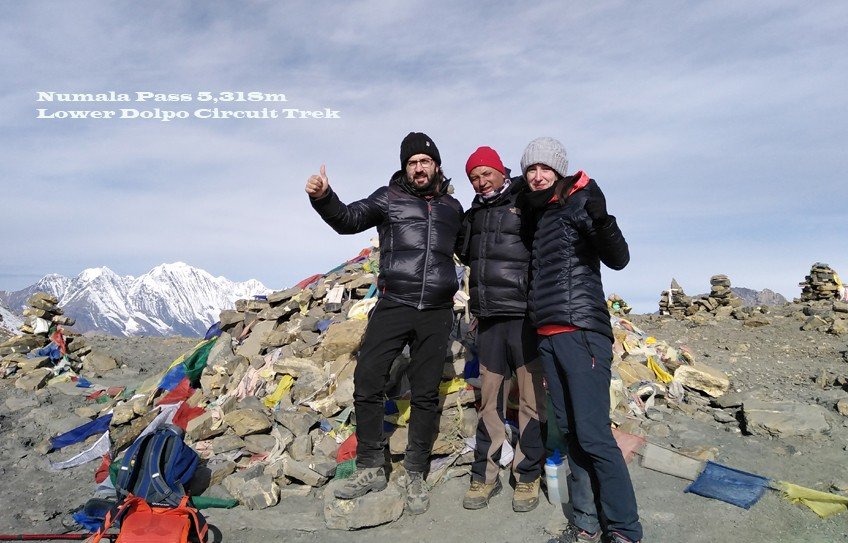
- Experience the thrill of traversing the Himalayan high passes, Numala Pass (5,318 m) and Bagala Pass (5,070 m).
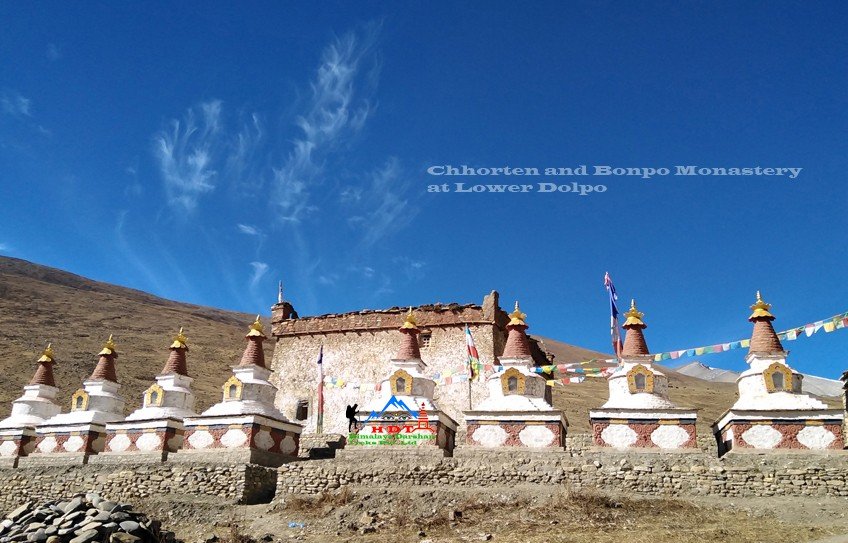
- The region is home to both the Tibetan culture and the unique Bon Po culture.
- Old and historical monasteries
- Trekking through Shey Phoksundo National Park allows you to enjoy the diverse flora and fauna of the area.
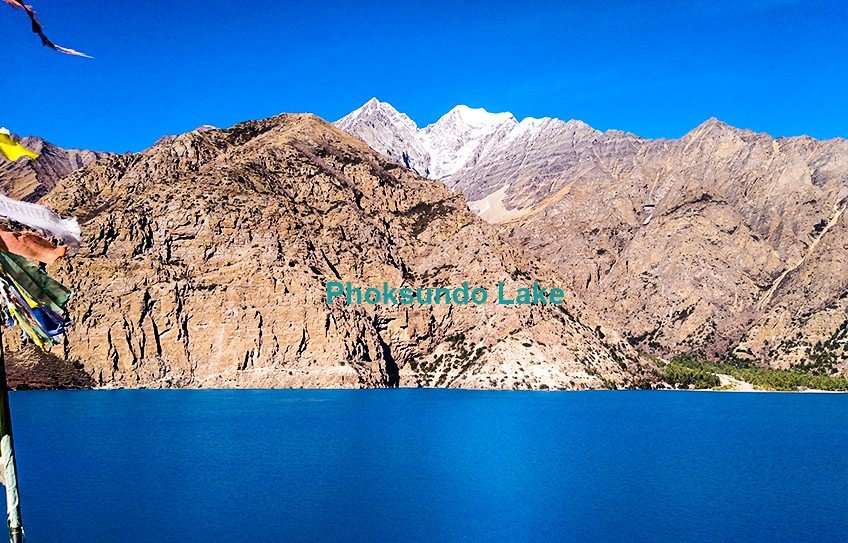
- The crystal blue water of Shey Phoksundo Lake, which is the deepest lake in Nepal, is a stunning sight. The biggest waterfall.
Explore Shey-Phoksundo Lake
The spiritual heart of this trek is visiting ‘Crystal Mountain‘ and several unique 11th-century monasteries (gompas). One important pilgrimage site for Tibetans is Shey Gompa. You’ll have the opportunity to experience life in the remote highlands. Furthermore, the incomparable beauty of the Shey-Phoksundo Lake—turquoise blue emerald colors surrounded by steep, bold rocks and yak caravans—is the major highlight of this trek. The Dolpo Circuit trek is an incredible experience that you will never forget.
Dolpo Teahouse Trek
This trekking package is a combination of a teahouse trek and a camping trek. Mainly, we focus on the teahouse trek, but it is still not possible for a full teahouse trek. Now it is only possible for a normal teahouse trek/homestay. However, we still need to set up our tent in some locations. If you are interested in a full camping trek, please let us know. We are happy and ready to organize your Lower Dolpo Camping Trek. If you have a short holiday and are interested in a full Tea House Trek, please let us know. We provide the Dolpo Tea House Trek.
The Lower Dolpo trekking trail passes through various landscapes ranging from green pastures to barren rocks that extend into the Tibetan plateau. On the way, you’ll experience small but unique, authentic villages imbued with Tibetan culture and tradition. Buddhism and Bonpo are the oldest spiritual traditions of Tibet. They are essential for the people living in these villages.
Lower Dolpo Circuit Trek’s Best Time
Finally, the best time to do the Lower Dolpo Circuit Trek is from April to October. Dolpa is a desert and a rain shadow area. So it is suitable to do trekking in the monsoon season. But occasionally this month, it’s challenging to reach Dolpa due to rainfall in the lower part and bad weather from Nepalgunj to Juphal.
What are the best parts of the Lower Dolpo Circuit Trek?
The beautiful Shey Phoksundo Lake, which is known for its deep turquoise color and lack of aquatic life, is the best part of the Lower Dolpo Circuit. Some other things to see are
Dho Tarap is one of the highest places where people live in the world.
Bon-Po Culture: A rare chance to see spiritual practices from before Tibetan Buddhism.
Wildlife: You might see rare animals like the snow leopard and blue sheep in Shey Phoksundo National Park.
High Passes: The Numala Pass (5318 m) and Bagala Pass (5220 m) both have outstanding views of the western Himalaya, including Mt. Dhaulagiri.
Final Thoughts: A Trek for Real Himalayan Adventurers:
If you just want to hike, the Lower Dolpo Circuit Trek isn’t for you. It’s for people who want to see rare wildlife, love adventure, and enjoy an amazing combination of nature and culture. This trip is truly one of a kind because you will cross the adventurous Numala and Bagala passes, walk through remote valleys, and trek in one of the last strongholds of the snow leopard in the world.
The beautiful scenery and the sense of discovery that this hike gives you are what make it special. Every day is quiet, every village has a story of how they survived, and crossing every high pass feels like a win for you.
For trekkers who value authenticity over comfort and wilderness over crowds, Lower Dolpo delivers an experience that few places on Earth still can.
If you are searching for a trek that challenges you physically, rewards you spiritually, and connects you deeply with the raw Himalayas, the Lower Dolpo Circuit trek is more than a destination—it is a once-in-a-lifetime journey.
Are you ready to book this trip?
To book this trip or for more inquiries, you can click Book this trip from our web page. We have many different trekking and tour packages, so you can choose your most suitable trek/tour with us. HD Treks suggests early booking so you have enough time to prepare for this trek. We are ready to organize your trek based on your travel bucket list. You can also contact us by WhatsApp at +977 9841073239 for quick inquiries.
Booking Procedure
Himalaya Darshan Treks makes it easy and safe to book your trek to the Lower Dolpo Circuit. HD Treks is a fully registered government company with more than ten years of experience trekking and mountaineering in the Himalayas. We are also proud members of NMA and TAAN. We guarantee professional service from the beginning to the end of your trip. To confirm your reservation, just send a 20% deposit by bank or wire transfer to our official bank account. Thereafter, we’ll send you an email with the final confirmation.
Please send us a copy of your passport, travel insurance information, and flight information within a week of making your reservation. You can pay the rest of your balance in cash at your hotel in Kathmandu or by bank transfer a week before your flight to Nepal.
Frequently Asked Questions
What does the name “Land of the Snow Leopard” mean for Dolpo?
Dolpo is the best place for the rare wildlife, the snow leopard. Shey Phoksundo National Park and Kanchenjunga Conservation Area have the most snow leopards. So, Dolpo is best for travelers who love wildlife and want to see it. The quiet and solitude of Shey Phoksundo National Park make it a safe place for these rare animals, unlike the busy trails of Annapurna. If you are also interested in seeing this rare wildlife, join us for our Dolpo region treks.
1. How difficult is the Lower Dolpo Circuit Trek?
The trek is considered moderate to challenging. While it doesn’t involve technical climbing, the remote location, high altitude, and long trekking days present physical challenges. Trekkers should be in excellent physical condition and experienced in high-altitude treks. The Numa La and Baga La Passes are the challenging high passes in this trek.
2. How to reach the Lower Dolpo Trek?
The Dolpo region is located in the western part of Nepal. To reach Lower Dolpo, you first take a flight to Nepalgunj and then fly to Juphal, which is the starting point of the trek. From Juphal, you will begin a lower Dolpo circuit trek, passing through various villages and natural landmarks, high passes, and beautiful Phoksundo Lake.
3. How many days does it take to do the Lower Dolpo Trek?
The 16–18 days are enough to complete this trek (from Kathmandu to Kathmandu). We, Himalaya Darshan Treks, offer 17-day itineraries and packages for this trek.
4. Do I need permits to visit the Lower Dolpo Circuit Trek?
Yes, you need a Dolpo Trek special permit and a Shey Phoksundo National Park entry permit. With these permits, you can do the beautiful Lower Dolpo Trek.
5. What is the permit cost?
The Dolpo region is a remote and off-the-beaten-path trek and a popular trekking region in the western part of Nepal. There are two parts of Dolpo: Upper Dolpo and Lower Dolpo.
- The lower Dolpo Trek special permit cost is $20 per person for one week. Likewise, there is an additional fee of USD 5 per person for each week beyond the initial week.
- The entry permit fee for Shey Phoksundo National Park is NRs 3000 per person.
6. What should I pack for the trek?
For the trekking gear and packing list, visit this: Trekking Gear.
Itinerary
Day 1, Arrival in Kathmandu (1,350m), and transfer to hotel
We, Himalaya Darshan Treks, heartily welcome you and your group to Nepal. One of our company staff will take you to your hotel in Kathmandu. The person will be waiting outside the baggage hall of the Tribhuwan International Airport, Kathmandu, holding an A4-size paper with your name and our company name. So, you have to look for that person for your pickup from the airport. Your check-in at the hotel.
Day 2, Fly to Nepalgunj, Transfer to hotel.
Today, you have free time until afternoon. This day is required to make the Lower Dolpo Trek special permit with your original passport. So completing the documentation, then ready for the flight to Nepalgunj. By afternoon or evening flight. It takes about 1 hour to reach Nepalgunj by flight. Transfer to the hotel.
Day 3, Flight to Juphal (2,475m) and Trek to Dunai (2,150m).
An early morning 45-minute flight lands us in Juphal, and after a brief sorting and introduction of our crew, the trek finally starts. The trek heads toward Dunai, the administrative headquarters of Dolpo. Stay at the tea house.
Day 4, Trek to Tarakot (2,540m).
A series of streams trace the route for the day through deep pine forests and terraced hillsides to Tarakot, a walled settlement perched defiantly atop its magnificent hillside, with a plethora of flagpoles sticking proudly among the homes. The nearby Sandul Gompa monastery is well worth visiting along a walkway lined with several chortens and mani walls.
Day 5, Trek to Laieni odar (3,370m).
The trail climbs steadily during the day, passing through dense forest and past a succession of gorgeous suspension bridges until we reach Laini Odar, a former construction site with a stunning cliffside setting and a neighboring cave that gives suitable refuge in inclement weather.
Day 6, Trek to Nawarpani (3,645m).
As we steadily ascend beside the banks of the Tarap Khola, the lush forest of the previous day presents way to desolate vistas, with alpine animals such as yak and blue sheep on display. The day comes to a close with a magnificent suspension bridge across the Chaya Khola and our arrival at Nawarpani village.
Day 7, Trek to Do Tarap (3,944m).
The Tarap Khola leads the way for the first part of the day, bringing us through an undulating trail that peaks at Charka La (4920 m) before descending into a tight valley with such a deep ravine that the lower pathways are only lit by the midday sun. Chhortens and stupas line the path to Dho Tarap, with the Tibetan village’s whitewashed Gompa standing majestically at its center.
Day 8, Acclimatization Day.
After breakfast, hike to the Do Tarap viewpoint. It is a really nice and beautiful place to visit. A day to relax and adjust to the higher altitudes, with Dho Tarap providing an excellent chance to explore its various charms and watch the traditional Tibetan lifestyles of its friendly residents, who still trade with their ancient homeland to the north via their yak caravans. Visiting the Gompa offers a network of fascinating laneways to explore.
Day 9, Trek to Numala Base Camp (4,440m).
A large, wide main trail runs via Crystal Mountain School, then through Taksi hamlet. It takes an hour to travel from Dho to Taksi. Another hour on the same trail leads you into a small Tokyo village. The trail begins to ascend in a moderate manner, leaving the valley and the main trail behind. After another hour, a little stream and a broad valley appear on the left side of the main valley that comes from Dho. (Some groups call it Base Camp and set up camp along the river.) After crossing the brook, the trail begins a steep climb up a ridge. The path runs through a number of little stacks of many stone plates. The steep ascents continue all the way to the Numala Base Camp.
Day 10, Trek to Danigar (4,630m) via Numa la pass (5,318m)
On the crest, the steep climb continues, and after 30 minutes, a quick traverse begins. For the next hour, there will be another ridge and another tough ascent. The climb comes to an end at Numala Pass (5309 meters). Numala offers views of the Dhaulagiri Range to the east and the Kagmara Range to the west. A steep fall into the main valley leads to the valley’s bottom, where there is an intermittent stream. The trail follows the creek for a short while until it comes to a fork. The trail then crosses the river and proceeds left into the valley. Danigar is reached via a short, gradual uphill traverse. It’s a pasture near the valley’s end, flanked by high peaks. Among the ridges that surround Danigar, Norbu Kang is a noteworthy peak.
Day 11, Trek to Yak Kharka (3,985m). via Baga la pass (5,220m)
The day begins with a difficult ascent of the ridge visible from Danigar. After about 2 hours of steep trekking, you’ll reach a location with few main stones. Following the site, the steepness diminishes with strenuous walking, and a traverse to Bagala La’s summit begins. From the main stone site, it takes about 40 minutes to go to Bagala La.
After Bagala La, the descent is a little difficult, passing through stones and scree. After an hour, the trail enters a valley and begins to follow a creek. The creek winds its way through the valley, and after less than an hour, the trail departs from it and begins a steep descent to Phedi. The trek descent continues through Phedi and then transitions into a pleasant and easy hike to Yak Kharka.
Day 12, Trek to Ringmo (3,740m), Shey Phoksundo Lake.
The trail pleasantly traverses for half an hour after leaving Yak Kharka. Then, gradually, a steep ascent begins, lasting nearly an hour until it halts when faced with a prayer flag. The ascent now becomes easier, and on the opposite valley, a massive cascade rises.
Near the trail, juniper trees and some fields appear, and the Rigmo settlement appears soon after. The entrance to Rigmo village is marked by a bridge that spans the Phoksundo River, which flows out of Phoksundo Lake.
Day 13, Rest Day.
A whole day to explore the gorgeous lake waters and their surroundings. Tshowa, a medieval Bon monastery founded over 900 years ago, is close and offers more exploration chances.
Day 14, Trek back to Chhepka 2,838m.
The walk now begins through the Phoksundo River’s carved valley. After a 2-hour descent, you reach the Jharana Hotel. Until completion of the walk, the trail stays along or near the Phoksundo River. Short ascents and descents punctuate a pleasant stroll through Rechi’s little settlement. You spend the entire day in a narrow valley after leaving the Jharana Hotel. Chhepka is around 3.5 hours away from Rechi.
Day 15, Trek to Juphal (2,475m).
The trip follows the same path as the day before and goes into the same valley. On the way to Sulighat, the trail passes through the small communities of Sangta and Kageni. After Sulighat, the valley opens, and the journey continues along the Bheri River‘s bank till Dunai. The trail follows the Bheri River, with the last ascent taking about an hour to reach Juphal.
Day 16, Flight to Nepalgunj to Kathmandu. Transfer to hotel.
Early in the morning, we will fight in Nepalgunj. The itinerary also includes a flight to Kathmandu and a transfer to the hotel.
What is included in this package?
- All airport pick-up and drop-off by private vehicle (domestic/international).
- 3-night hotel in Kathmandu (twin sharing) with bed and breakfast.
- One-night hotel in Nepalgunj (twin sharing) with bed and breakfast.
- Experienced guide, porter, and all staff with salaries, food, accommodation, and insurance.
- Tea house plus Tented accommodation and 3 times meals during the trek (breakfast, Lunch, Dinner, and Tea/Coffee.)
- Lower Dolpo Trek Special permit.
- Shey Phoksundo National Park entry permit.
- All government and local taxes.
- Tent and food where there are no tea house facilities.
- Both-way flights for guests and guide from Kathmandu to Nepalgunj to Juphal (Dolpo) and Juphal to Nepalgunj to Kathmandu.
- We will hire a local porter and all the needed staff at Dolpo.
- First Aid medical kit and an oximeter to check pulse, heart rate, and oxygen saturation at higher altitudes.
- Emergency Helicopter service arrangement (If needed) which will be paid by your Travel Insurance Company.
- We will arrange a Duffel bag, Sleeping bag, Down Jacket, and warm hat (If you don’t have your own.)
- Himalaya Darshan Treks branded T-shirt as a souvenir.
- Lower Dolpo circuit trek achievement certificate.
- Lower Dolpo Trekking Map for a group.
- Farewell dinner in Kathmandu with a culture program.
What is excluded in this package?
- Lunch and dinner in Kathmandu and Nepalgunj.
- Extra night accommodation in Kathmandu and Nepalgunj than the scheduled itinerary.
- Your expenses (Laundry, bar bills, battery recharge, bottle or boiled water, hot shower, etc.)
- Tips for the guide and staff. (Tips is expected.)
- Delay due to weather.
- Travel Insurance (Recommended)
- Nepal entry visa fees, (USD – 30 for 15 days / USD 50 for 30 Days)
- Desserts: Sweet things like chocolate, cake, pie, pudding, etc.
- Any other expenses that are not mentioned in the cost are included.
- Sightseeing in Kathmandu and Nepalgunj.
Photo Gallery
Responses & Ratings
One Reply to “Lower Dolpo Circuit Trek”
Leave a Reply
Fixed Departures
| Trip Start, End Dates | Price p/p | Space Left | |
|---|---|---|---|
| May 25, 2026 - Jun 09, 2026 | USD 2199 | 2 | |
| Aug 19, 2026 - Sep 03, 2026 | USD 2199 | 4 | |
| Sep 15, 2026 - Sep 30, 2026 | USD 2199 | 3 |
Related Packages
-

Upper Dolpo Jomsom Trek - 25 Days
One of the most adventurous and rewarding treks in Nepal is the...
- Max-Altitude: 5360m
- |
- Group Size: Min 2+
-
Gokyo Lake Trek - 13 Days
Trek to Gokyo Lakes with Experts—Himalaya Darshan Treks, Your Local Guide to...
- Max-Altitude: Gokyo Ri 5360m
- |
- Group Size: Min 1+
-
Tilicho Lake Short Trek - 9 Days
Tilicho Lake Trek —explore the World's Highest Lake in the Annapurna Region!...
- Max-Altitude: Tilicho lake 4,920m
- |
- Group Size: Min 2+
-
Langtang Gosaikunda Trek - 13 Days
The Langtang Gosainkunda Trek is a well-known trekking route in Nepal. Set...
- Max-Altitude: 4,610m
- |
- Group Size: Min 1+
We just finished the Lower Dolpo Circuit Trek and we couldn’t be more happy about the whole experience, and this is also thanks to our guide GB who always made sure we were feeling comfortable and safe throughout the whole trek. He was always willing to explain and talk about Nepal’s culture and its natural landscapes, we learnt so much about Nepal and especially about the Dolpo region and its ancient Buddhism (Bon) thanks to him.
He is a very experience guide who started as a porter when he was barely a teenager, so he knows the mountains by heart. Very attentive and really easy to get along with.
If we come back to Nepal (we will surely do), we will make sure to go with GB for another trekking adventure. Thanks GB!